Milson is not just another name in the mix, he’s someone you vibe to without understanding him. Most people know him for D&B where he has made quite the name for himself, that is the surface level and the sound that introduces him, but there is far more beneath that. He has real range and an insane amount of versatility, the kind that can’t be manufactured, the kind that comes from lived experience as opposed to imitation.
Milson has faced hardships that he doesn’t speak about, no public statements, no attempts to gain sympathy, and no need for attention. He keeps it to himself and channels it into his music. That is why it connects the way it does. There is so much natural emotion and honesty in it. That kind of authenticity cannot be replicated.
What separates him further is his versatility. While D&B may be what people associate him with, he’s not confined to it. His creative ability stretches so far beyond just a D&B. He experiments, he adapts, and he proves that he is capable of much more than what people might expect. That willingness to grow is an incredible sight to witness, especially knowing what’s to come!
At this stage, Milson is working on a project that feels significant. It is still early, but there is clear intention behind it. This is not just another release, it’s a statement of who he is and where he is heading so sit back and enjoy. He’s about to show the world why he deserves recognition at the highest level.
Beyond the music, his character stands out just as much. Milson is present for the people around him. He supports his friends without hesitation, uplifts local businesses, and shows genuine respect to other artists. He gives back to his community in a way that is natural with no force or performative behaviour. Someone who gives without expecting anything in return, someone who continues to support others even while working towards his own goals. That speaks to his values and the way he carries himself.
His “I’ve made it” moment is approaching, and when that moment comes, it won’t only reflect his journey, but also everyone who has supported him along the way. It will make sense.
The Final Product
By: Alex Luczakiewicz
You’re always judged on the final product and not what it took to get there.
Would people judge things differently if whatever it is that you achieved or put out there was achieved quickly? What if the outcome was created in six months when it could have taken two, would their judgment change?
Nobody seems to ask about the process, about the early nights that stretched into the early hours, or the endless set backs and obstacles that you had to overcome to get a fraction of the work done. They don’t see the versions of you that almost quit, the ones that sat in silence starting into space ready to throw the towel in. They just want the clean version that skips straight to the outcome for the convenience of making a quick decision or a quick judgement.
The most interesting thing about often working with new people and always aiming to converse on a deeper level, is understanding them. Connections are built through understanding the five W’s because the real stories come from everything people skip over.
What you learn from the missed chances, the ignored messages, the times you showed up and nobody showed back, is amazing. Learning how to face rejection and failure and not run from it is a lesson that only you can learn alone. They can’t teach you this stuff in educational environments. And the sad reality, most people’s mindsets don’t allow them to turn negatives into positives.
You build instincts you can’t fake. That doesn’t come from winning, it comes from getting it wrong, over and over, until you really understand.
The journey isn’t some obstacle standing between you and the result. It’s the whole thing. The result is minor in comparison to your journey and if you take that away the journey then the outcome is left with no meaning.
While most think you’re chasing something or working towards something, you’re actually becoming something so much bigger than anybody could imagine.
Pray For Me?
By: Carley Divish
A neighbour offered to pray for me a couple months ago. I know that often religion can be thrown in your face: the revelers by Westquay with their microphones or the Jehovah’s Witnesses by Poundtown (my better name for Pound Land). They both demand attention, and in today’s world that can be a little obtrusive. But this was not, she wanted to tell her story of finding religion and maybe offer support if I needed it. Because of this, I have not thought too much about the religious aspect. Instead, I have been focusing on the gesture.
The offer came when one day she slipped a note through the letterbox, giving her phone number, her name, and why she was giving this note. Although she did seem kind I did not have anything to ask of her. But the offer, the nonchalant, unexpected, generous offer was clearly notable, as I am still thinking about it months later. I have wondered why that woman’s note stuck with me so long. I never reached out to her, and I don’t even know if I still have it anywhere. For all I know I let it get lost along with the receipts for drinks I bought and train tickets that were washed in my trouser pockets.
In the end I found this: I think that her offer to pray for me is the direction where the community in our city should grow. I read all her words, taking them in, sharing for a moment how she finds calm in her faith, and feeling happy for her. She seemed like a sweet girl who found joy and wanted to share it. She did not push, and I still do not know what she looks like, but she has been the only neighbour to ever introduce themselves to me. When I try to talk to the revolving door of people living across the hall from me, they are surprised when I hold the elevator for them. They are almost taken aback when I remember that they are living in one of the three apartments on my floor (it is not that hard to remember what 5 people total look like). But this girl reached out. She offered to take her time, her love, her faith, and give it to me for nothing.
I often try to reciprocate that spirit. Offering a kind word or making a new friend out of the man who works the grocery store tills, but in a city where addressing social isolation between all age brackets is an official goal of the council, it is not easy. When I was in undergrad, I lived in a city for 4 years. At the end of those years, I saw friends on every corner. I could not go out for an evening without seeing someone I knew by accident. Here, when even Bargate and Portswood are at a high risk for social isolation, how do you begin? A key factor in social isolation is ‘low neighborhood belonging,’ or when you do not feel connected to your community on a smaller scale than the entire city. Along with that, 55% of young people in our city don’t have the money to go out to events. This isolation only gets worse when we get older, so why not fix it now, before it gets worse?
While we each can do things like saying hi to familiar faces on the street or in shops, it is a larger action that we need. Council-run or subsidized events that do not sit behind paywalls are necessary, for every age bracket. Our participation in the ones that do exist can show how we want more. Similarly, transport links across the city can help address this problem. I would like it to take less than 3 buses and a walk to get from my place to the nature preserve north of Shirley. I would like to go to Hobbycraft without it being a day trip. People cannot create community, reverse this seclusion if they simply cannot reach each other or common spaces. Finally, the loss of third spaces for youth is integral. I go to the public library and am told that if I leave my backpack even to go grab a book from a shelf it will get stolen. I still go, though, because there are very few other spaces that do not expect money. Safe, accessible, free spaces are key in addressing this isolation. There are initiatives happening across town, with a knitting club at the library, the vegan kitchen at October Books, and others, but isolation is still an issue that needs to be addressed on a larger scale, not just by individual businesses and locations.
Creating friendships wherever you go is what turns a place from a location you live to a home you will stand by. People need to belong. In a city like Southampton, I think that creating community, reaching out to others, offering a prayer, a dessert, a kind word can go a long way, even if we still need support from larger organisations. No one wants to feel isolated, whether you are 14 or 83, and it takes every day kindnesses along with institutional change to create the place we all want to live. I’ll still think about the girl who offered to pray for me and hope she’s doing well. Maybe someday I’ll meet her, but until then, I will continue my conversation with the man who works the tills at my grocery.
Your Application Has Been Unsuccessful
By: Alex Luczakiewicz
What do creatives need to do to be seen when applying for jobs?
A stand out cv and a cover letter that shows personality? Not enough. A portfolio of work that shows drive, passion, creativity and a lot of promise? Not enough. Originality? Not enough. More than enough capability to be an incredible asset to most creative roles? Still, not enough.
This makes us question whether employers reject us before giving our applications a glance.
But the worst part, knowing that you’re the missing piece of the puzzle with that glimmer of hope that you will get the email stating that you have been progressed onto the next stage of the hiring process.
Rejection after rejection but we keep on going. But why? Everything happens for a reason and one day, an employer will reach out to you with the same feeling of hope you have when that job looks like the perfect fit. You’re a diamond in the rough just waiting to be found.
Keep on writing, keep on drawing, keep on singing, keep on recording, keep on creating. All you need is a single chance and everything will fall into place.
My Thoughts Get Too Loud
By: Alex Luczakiewicz
I’m a creative.
I think outside the box when I don’t need to.
I over complicate easy projects with intricate ideas that lead to overstimulation.
I want everything I do to be different.
I am my own worst critic.
I hate everything I do.
I burnout.
I love to learn but my attention span is short.
That person’s cool, would they collaborate?
Am I good at what I do?
How do I get better?
What inspires me?
Everything.
My thoughts get too loud.
I have unfinished ideas stacking on top of each other. I feel pressured into holding remembering every new creative thought before it disappears. My own imagination can be the bane of my life, it is EXHAUSTING.
However, my loud thoughts are where everything I create comes from. Every piece of writing, every idea, every moment of clarity started as noise in my head. The same things that overwhelm me to the extend of a burnout are also the things that allow me to see the world differently, see people differently and appreciate in ways that I once did not.
The vast majority of us share the same issues and it’s never the lack of ideas, it’s that we have too many. Our minds can sometimes feel louder than the outside world, like walking into a busy crowded room full of conversation, but not being able to make out a single word. One slight observation can spiral into a never ending chain of ideas that become too overwhelming to bear.
Loud thoughts can keep you up at night. They interrupt conversations. They make sitting still become difficult and when your mind is always generating ideas, when does it switch off?
The goal really isn’t to silence your thoughts, the goal is to translate them into something that you can understand, giving your ideas another place to live. We all knowingly go through this as creatives, yet we all seem to feel alone in the process.
But I Bought Groceries Yesterday
By: Carley Divish
In a time where shopping online is as easy as finding Shein clothing at the charity shop, I advocate that you don’t sit and swipe on your phone; at least, not for your groceries. This is not an anti-phone tirade. We have all already heard those to death, and while I do have a stance, that you can probably imply, I don’t need to say it. In this article, I am not advocating for taking your brain back, switching to a dumb phone, or any of those new wave woo-woo (scientifically proven) activities. I am advocating for the love of grocery stores! For the beauty of finding a new favourite food in an unexpected place. For uncovering the secrets hidden between the frozen peas and mini yorkshire puddings.
Every time I enter a new city, whether I am visiting, have a kitchen, have just eaten or am more ravenous than the whale that ate Jonah, I love going to the grocery store. Any of them! To me, this run-of-the-mill building reveals what I could otherwise never understand in just a day. The store is anthropology without trying, selling the everyday items of whatever culture I’ve come across: the food, fashions, alcohols, reality. Is there a fresh bread section? Are there strange fish? Cute pastries? What are the popular chocolates? There is so much to learn about a people, a culture, even the specific place just by going to the grocery store.
In a city where 15.4% of us don’t have English as their main language, that is still over 37 thousand people (Southampton.gov 2022). Even then, 31% of school students had a first language other than English. Finally, 41% of births in Southampton in 2022 were to women who had not been born in the UK (Southampton.gov 2022). While I bet some of them were cruise ship emergencies, that is an amazing number! This city has culture, and it has cultures. Both are good to explore, whether you are born and raised English, twenty generations back, or just showed up a couple years ago, like me.
The Thai festival last year exploded from the year before, with a gazebo with a few stalls and performances turning into a full on, park encompassing, gated off, party town. Just a year before, the cleaning professional in my dorm had invited me. At that time the Thait festival was a small celebration in Palterston Park, with acts, food, and a good crowd, but nothing compared to the lines outside the gate a year later. Culture in this city is exciting! And what is more exciting, is the grocery store that accompanies it! Asian Supermarket off of Castle Way and Bargate Street can show you culture all the time, and maybe make you expand your palate, with Triple A Cafe sitting on the first floor. The Italian grocery, M3 Market, sits next to the Polish, Delikatesy Smaczek, just south of Vincents Walk, and all three have given me food I never would have tried before (and a place to wander on a rainy day). All of these places are run by locals, sharing their culture and creating a hub for the cultural diaspora in our city.
I’ll tell you a secret, I once went to one grocery twice in a day just for cake, and it was the same cashier! In the moment, it was embarrassing for the cashier to call me out! But now, I laugh about it. It is not bad to love a local business, they will love you back for it. On the other hand, I once bought food from another cultural grocery store that I hated. It just was not my cup of tea, but I still go back and try new things that I end up buying again and again. I have not been to Italy or Poland yet, but through these local businesses I know a bit about the culture, or at least the minority culture that has created new cuisines (like spaghetti and meatballs or gumbo). I enjoy my days when I can have a nice wander around the aisles, see the food I would never have known, and maybe try some. I bought a huge hunk of the best butter I ever had, just to try something new, and now I faint at the thought of going back to regular Lidl butter. These are foods that people eat, not just restaurant staples: they embody the authenticity we are all searching for, without the struggle between engaging in a new culture and treating it as a commodity. While I am definitely not Italian, Polish, Thai, I can still feel the honesty and the joy of these places through knowing what they eat.
Swiping on your phone is easy, getting someone else to buy your groceries is easy. You’ll likely save some money, save some time, save save save. As Kurt Vonnegut said, “I…go out to get an envelope because I’m going to have a hell of a good time in the process of buying one envelope. I meet a lot of people… I give them the thumbs up…And, what the computer people don’t realise, or don’t care, is we’re dancing animals. You know, we love to move around.” Dance around! See the grocery store! Say hi to the clerk even if you’re buying a second piece of cake. You will miss life if you let it go by you, and in Southampton there is so much life to live. So much food to try that expands beyond Lidl’s ‘country of the week.’
Stretch your legs, stretch your curiosity, experience culture. Go to the grocery store.
Sources: Ethnicity, Language, Identity. 2025. Southampton Census. https://data.southampton.gov.uk/population/ethnicity-language-and-identity/ Filgate, M. 2007. God Bless you, Mr. Vonnegut. God Bless You, Mr. Vonnegut – CBS News R. Gilbert-Jones. 2024. How Authentic Experiences Shape the New Tourism Economy. Skift Research. How Authentic Experiences Shape the New Tourism Economy – Skift Research




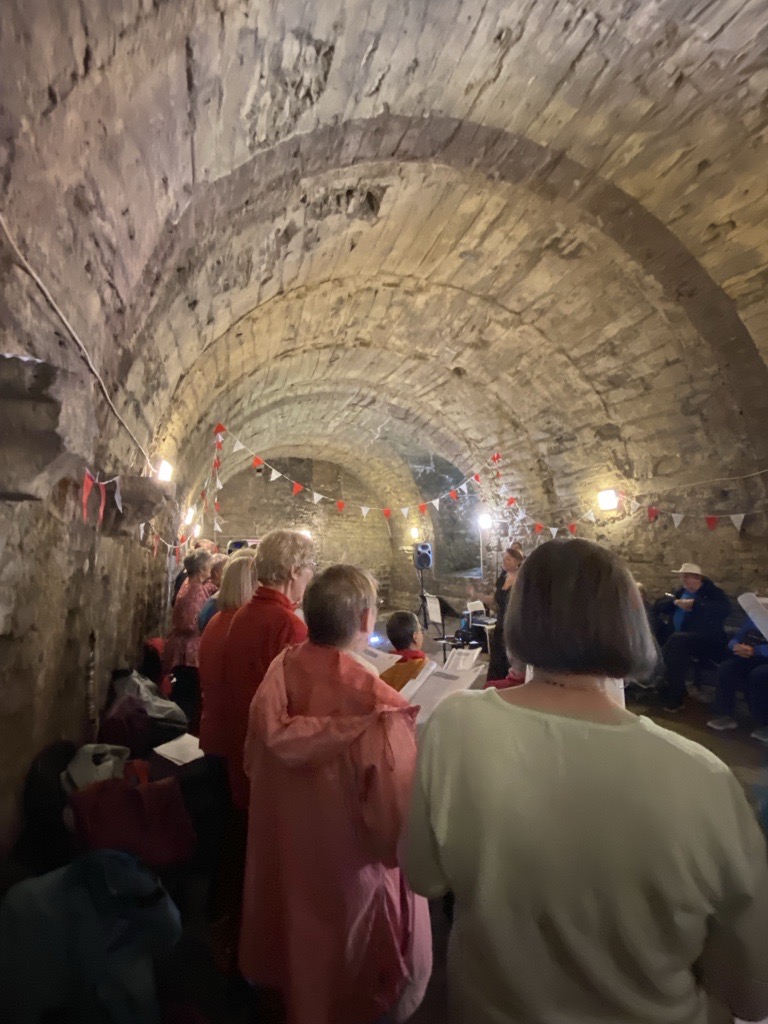


 Growing our community.